


In the mid 1970s, if you wanted a microwave oven, you ordered it out of a Sears or Montgomery Ward catalog, maybe on lay-away. There was no big box store. It came in a heavy box that sat on your counter and took up half of it, because kitchen cabinets had not yet been designed with a slot above the range.
As big as they were, they had everyone worried. Was this going to be the end of restaurants?
Don’t laugh, it was a real topic at the (microwaved) dinner table. If a family could put dinner on the table in four minutes, why would they pay someone else to cook it, drive across town, wait for a table, and tip on the way out? Convenience would win. The restaurants would be empty.
Well, that was obviously wrong. The specific way it was wrong is how I have been thinking about generative AI right now. I get this question a lot, so stick with me for a “hot” minute.
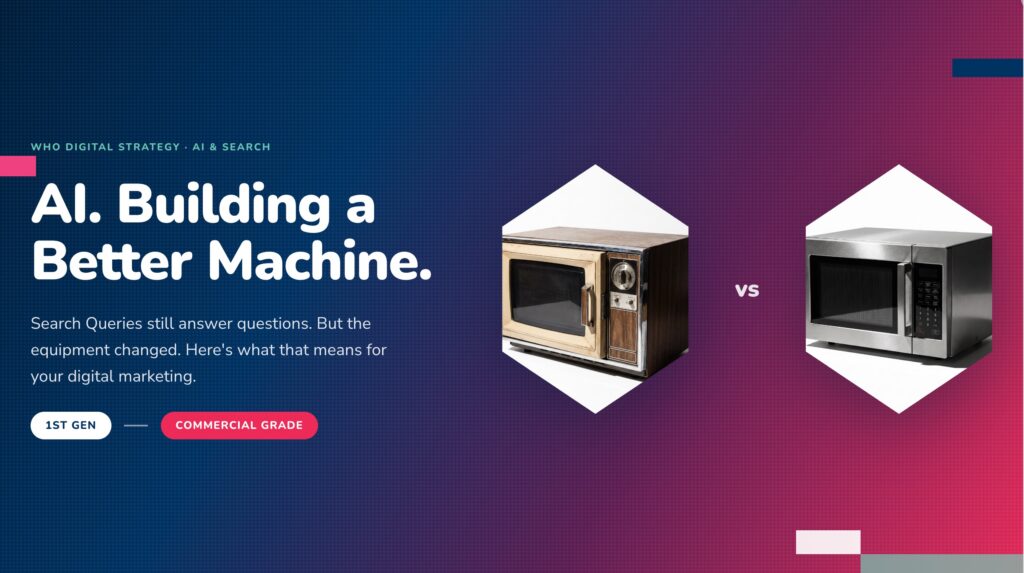
Restaurants grew alongside the microwave
Restaurants grew. Americans spend more on food prepared outside the home today than they did in 1975, and according to USDA data, spending on dining out passed grocery store spending for the first time in 2015. The appliance that was supposed to crater an industry sat in most American kitchens while that happened.
The time did not come back either. Nobody took the twenty minutes they saved on dinner and sat down with a book. The saved time was absorbed into a busier baseline immediately: two incomes, longer commutes, kids in more programs, more evenings with something scheduled in them. The microwave did not give anyone an hour. It raised the floor for how much a household could get done in an evening, and then everyone’s evening filled up to the new floor.
And restaurants got better. Once reheated food became the default at home, going out stopped being about getting fed and started being about craft, service, and sitting across from someone. The occasion became the thing worth paying for.
The microwave created industries nobody predicted
The forecast missed the industries that did not exist yet.
Microwave popcorn became a category out of nothing in the early 1980s. The frozen aisle expanded from a shelf of TV dinners into Lean Cuisine, Amy’s, and eventually the entire Trader Joe’s freezer section that people plan trips around. Hot Pockets launched and created the handheld frozen food category.
Then there is another layer you couldn’t see even in the late 70s. Susceptor films, crisping sleeves, and steam vent bags are packaging technologies invented for an appliance that did not exist a decade earlier. “Microwave safe” became a materials standard with testing labs and compliance work behind it. Convenience stores and gas stations built hot food counters that now account for a real share of how Americans eat. Office break rooms became standard, which changed lunch culture, which enabled a packed lunch economy that grocery stores still design around. Going off to college now includes a full mini-kitchen setup and my ramen noodle recipe hacks are probably a thing of archival history.
Nobody in 1975 could have described susceptor packaging or barely crisping sleeves. There was no vocabulary for it yet.
Commercial kitchens adopted the microwave
Commercial kitchens adopted microwaves as a standard tool.
Restaurants use them for prep, for holding, for steaming and melting, for bringing a component up to temperature so a line can move at service speed. The tool went into the professional kitchen, straight into the workflow, and stopped being remarkable. No chef advertises it. No chef apologizes for it either. It did not replace anyone’s judgment about the menu.
It also never replaced the oven. It sits next to the oven. Different heat, different job, and anyone who ever tried to roast a chicken in one learned that within a single try.
The better question became which jobs it was good at.
AI threatens jobs the microwave never touched
A microwave never took a specific person’s job. It threatened an industry, and if that industry had contracted, people would have lost work.
Generative AI aims at technology jobs the hardest right now. Manufacturing and industrial jobs come next, as robots on the factory floor take over the work. Pretending otherwise would be ignoring headlines that keep us on edge. Those losses are real for the people behind those stats in the news.
Restaurant workers and food manufacturers had a generation to adjust to the microwave. The people affected by AI are getting quarters. Reskilling used to be something you could do across a career arc, and now it has to happen inside a crazy short window. That compression is a problem, but the tool (AI) is not what caused it.
The encouraging part is the knowledge workers and skilled tradespeople who are adapting are moving quickly, and they are pulling ahead. There is a growing gap between people who tried the tools and people who waited (or are still waiting). Which means urgency and curiosity about learning beats an attitude of resigned fate.
There is a quality objection too, and it is fair. Microwaveable food is frequently worse food. Convenience came with a cost, and plenty of people will tell you the nutrition suffered.
Watch what that did to the market, though. When mediocre food became abundant and cheap, good food became more valuable and easier to identify. It raised the value of the better thing.
That is what is happening right now. The internet is filling with average, plausible, sourceless writing. Work with experience and data behind it is easier to spot than it was three years ago, and it is worth more. Someone willing to put their name on what they wrote or built is worth more too.
We use AI more for code than writing copy
We have been using generative AI in this agency with human review at every step since GPT-3, and before that in commercial tools like Jasper. There were tons of experiments you never got to see. Finally, it is just part of our work (the microwave in the upscale commercial kitchen). But in a way different than I imagined.
Today it goes into codified skills and code built on more than fifteen years of SEO, paid search, and marketing data analysis. My methodology came first. The tooling caught up so we work Human, AI, then Human. We define what we are doing, have AI models of our choosing do some of the work, then review it against experience and guidelines. Sometimes we have different models evaluate each other while we build. There are always humans watching, testing, and deciding whether the result is worth keeping.
You may or may not have noticed the shift in how we work. We are transparent about it either way, and we will keep building with humans on the front end and the back end. I will be driving the improvements, testing frontier models, and staying ahead of this where it makes sense.
We use AI more for coding than for writing. That is the choice most worth sharing (and what surprised me). Because most of the industry is making the opposite one. Code is the reheating step from my microwave analogy. It is mechanical, repeatable, and testable, and when it fails it fails visibly. Writing is what we serve to a guest, and it carries our judgment about what is worth serving. A probabilistic model is a strong tool for the first job and a liability if you hand it the second one without a review. What we get out of it is consistency and efficiency, which we control rather than something the model provides on its own.
Do I have more time back? No. But, I am working more to be there for clients and also lead our agency in tooling, testing, and then retooling as we learn more. Even with all that, are we more efficient? Yes. Are we providing more value? Very much so. I haven’t been this excited about what we are doing in Search Marketing in quite a few years. It is fun. Fun means delivering even better results.
The microwave disappeared into the kitchen
Most people today do not think of themselves as owning one. It is just there.
Go buy or build a new house and it comes built into the cabinetry, stacked with the wall oven or folded into a convection unit that does three jobs from one door. Nobody walking through that kitchen thinks of the microwave as a separate thing they decided to buy. It stopped being an appliance you choose and became part of what a kitchen is.
AI is headed the same way. For a while it feels like a separate tool you go open, the way the microwave once sat on the counter taking up half of it. In a few years (or less) I do not think you will notice it as its own thing. It will be built into the software you already use and the way your business already runs, and you will reach for it the way you reach for a preheat setting, without stopping to think about it.
AI will change how the work gets done
AI will change how the work gets done. It is unlikely to change whether the work exists.
The time it saves gets spent, because most every competitor of mine is saving the same time and the baseline moves for everyone at once. Nobody banks it into an edge they can keep, but we can edge out on quality. What I do have is fifteen years of experience that lets me evaluate exactly how well the AI models are working and how to keep our guardrails in place. You haven’t tested an AI model until you have had a knock-down, drag-out argument about semantics and won. New industries are coming that we cannot name yet, in the same way that nobody watching a Radarange heat a cup of coffee could have described a steam vent bag.
The tool is here and I often say the “genie is out of the bottle.” Ask your business, which jobs it is genuinely good at, and which ones still belong to the person standing at the stove.
If you want to talk through where this fits in your own marketing, schedule a call with WHO Digital Strategy and how we are helping clients improve their business.