I’ve been using Plaud AI recently to record meeting notes, lectures, board meetings, and most of all conference presentations when I attended the 2026 SEOWeek in New York City for deep dives on AI visibility and optimization. More recently, I had the pleasure of being able to speak to a small but focused group of tasting room managers, operators, and winemakers that are part of the Texas Hill Country Wineries Association on AI and discoverability for their businesses. It’s lovely to be able to get to share your knowledge in a community where you’re a part of it in Fredericksburg, Texas. These are the Summary Notes as generated by Plaud AI of my talk. I think there are a few takeaways there for everyone, but I’ll let the notes speak for themselves.
WHO Digital Strategy expands on this with our AI Entity and Brand Blueprint that helps guide this for businesses like yours. Let us know if you have any questions.
Date Time: 2026-05-19 Location: Lost Draw Cellars, Johnson City, TX Instructor: Jonti Bolles, WHO Digital Strategy
Summary
On 2026-05-19, Jonti Bolles from WHO Digital Strategy led a candid, discussion-style session for Texas Hill Country winery stakeholders on how AI is reshaping discovery, digital marketing, and local search.
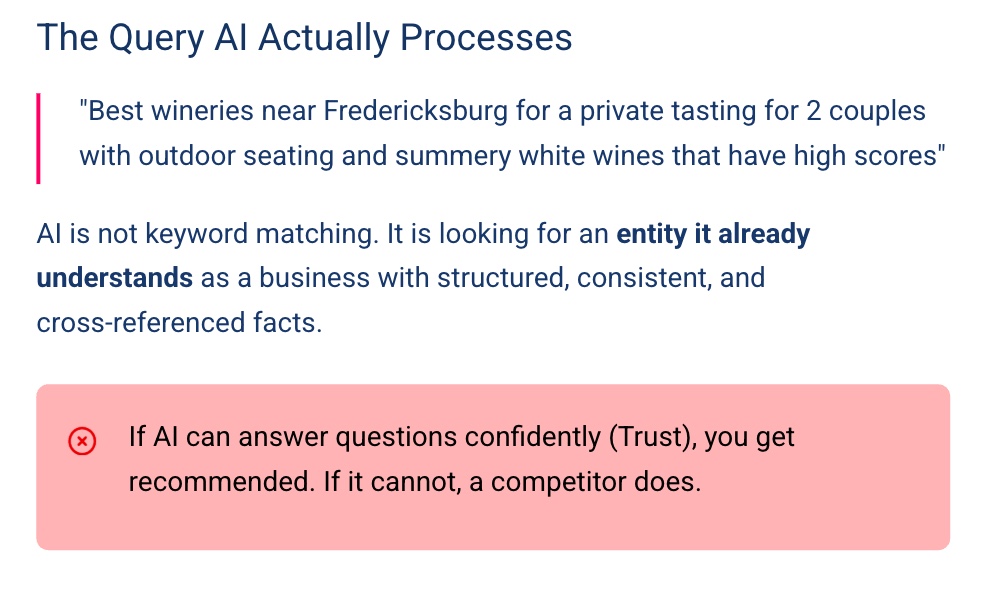
The core thesis: brands must be defined and maintained as entities with clear attributes and quantifiable values, corroborated across multiple platforms, to earn AI trust and appear in AI-curated itineraries.
AI systems (ChatGPT, Claude, Google AI Overviews) now cross-verify information from websites, Google Business Profiles, Apple Business, Yelp, TripAdvisor, Texas Hill Country Winery listings, Texas Wine Lover, social platforms (TikTok, Instagram, Facebook, LinkedIn), reviews, YouTube, editorial mentions, and even scanned print materials. Because users increasingly delegate trip planning to AI, visibility now depends less on keywords and more on consistent, attribute-rich entity data.
Messaging should avoid generic phrasing (“family-owned, rooted in the Texas Hill Country”) in favor of specific differentiators (e.g., outdoor patio, awards, varietals, tasting formats), with the website serving as the single source of truth. Jonti drew on agency experience (including work with Longneck Manor and the Fredericksburg Food and Wine Festival) and demonstrated entity modeling, semantic vocabulary, and SPO (subject–predicate–object) patterns that improve machine understanding.
Knowledge Points
1. AI’s Impact on Discovery and Trust
AI corroboration and retention
AI aggregates facts across owned and third-party surfaces, favoring trusted, consistent entities and deprioritizing those with thin or contradictory data.
The “10 blue links” era is giving way to AI overviews and conversational planning; websites remain the canonical source, but clicks concentrate around transactions (e.g., reservations).
Trust as the deciding factor
AI acts as a large-scale fact checker; insufficient trust leads AI to recommend a different, better-corroborated entity to preserve confident answers and user retention.
Green flags: consistent profiles, hours, amenities, awards, and reviews; red flags: outdated licenses, mismatched hours, vague claims.
Delegated choice and local classifiers
Users increasingly accept AI’s curated lists; “local” is often the first classifier, elevating entities with strong locality signals.
2. Entities, Attributes, and Values
Entity definition
A brand is an entity (a strong noun) with attributes (what it is/does) and values (quantifiable differentiators). Think “Wikipedia entry” structure.
Third-party sources (reviews, press, awards, directories, editorial mentions—even unlinked) strengthen AI confidence more than self-claims alone.
3. Website and Structured Communication
Depth and specificity
Replace vague statements with precise facts (founding year, AVA sourcing, tasting notes, varietal details, history, current accolades).
Publish comprehensive, timely content to become machine-ingestible source material.
Semantic vocabulary and SPO patterns
Build word banks (nouns/verbs/adjectives) and use subject–predicate–object sentences that map cleanly to machine parsing (e.g., “Winery offers outdoor patio tastings.”).
4. Cross-Channel Consistency Without Copy-Paste
Consistency as a signal
Ensure core entity facts, attributes, and values match across website, Google/Apple Business, TikTok, Instagram, Facebook, LinkedIn, directories, and reviews.
Tone can vary by audience (e.g., speaking differently to a granddaughter vs. grandmother), but facts must remain consistent.
Consistency gap test
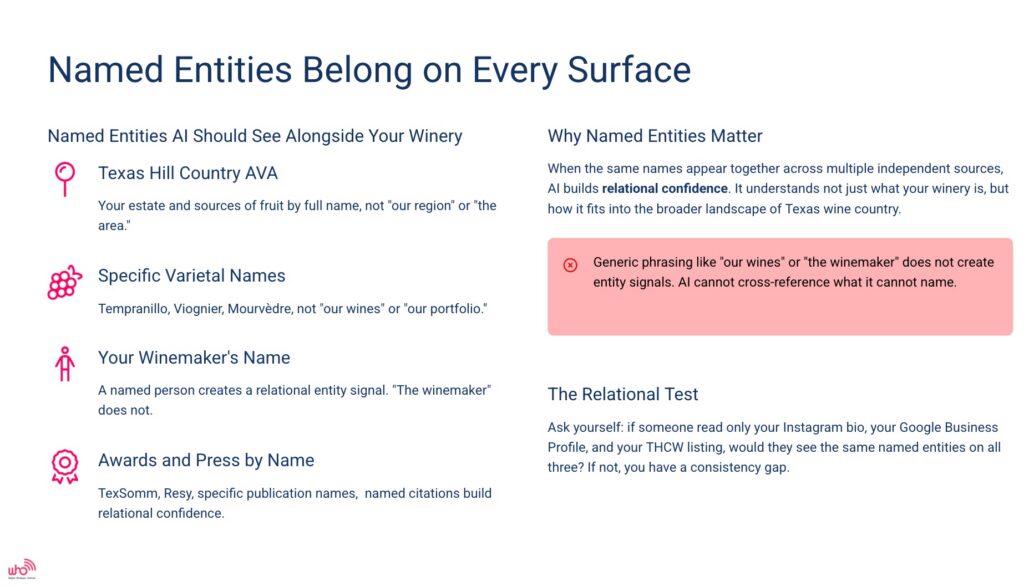
If someone reads only your Instagram bio, Google Business Profile, and Texas Hill Country Winery listing, do they see the same named entities and attributes? If not, fix gaps.
Critical elements
Keep hours identical everywhere; mismatches erode trust and cause AI to select other entities.
5. Audience Segmentation and Channel Strategy
Income- and age-driven behaviors
AI usage correlates with income: ~70% among $200k+ households vs. lower usage under $50k; high-net-worth visitors often use paid AI and are prime membership prospects.
Ages 18–34: heavy TikTok/Instagram/ChatGPT; 35–44: Instagram + ChatGPT; 45–54/55+: Google and word-of-mouth; some still use travel agents.
Platform loyalty is sticky; users tend to stay where they first learned (e.g., ChatGPT vs. Claude).
Visitor types and spend
Walk-ins: prioritize Google Maps and local listings; TikTok can spark spontaneity.
Destination travelers (highest spend): optimize AI visibility and entity presentation across AI assistants.
Wine club/repeat visitors: nurture via email, events, and owned channels.
6. Differentiation and Messaging
Move beyond generic claims
AI will not select based on clichés; specify unique proofs (e.g., “open-air patio for group tastings,” “TEXSOM gold for 2024 Tempranillo”).
Target audience definition
Explicitly state who you want to attract; clarity helps AI match the right visitors without excluding incidental referrals.
Realistic traveler phrasing
Use phrases travelers actually ask (e.g., “relaxing wine tasting in the hill country this weekend with an outdoor patio”), and ensure those attributes are corroborated across channels.
7. Reviews and Owner Responses
SOPs and timeliness
Respond to all reviews within 24 hours; assign responsibility and use templates that incorporate entities, attributes, and values.
Enriched responses
Reference location (Texas Hill Country near Fredericksburg), amenities (outdoor patio, private tasting room), staff (winemaker names), and varietals; reinforce positives and guide next experiences.
AI weighting
ChatGPT/Claude ingest review content and owner responses; thoughtful, fact-rich replies strengthen entity signals across platforms (Google, TripAdvisor, Yelp).
8. Trifecta Content and Trust Platforms
Trifecta content
Create resources that perform on website (evergreen authority), social (shareable), and PR (media-ready), aiming to become AI-referenced standards (analogous to King Arthur Flour charts, Angie’s pricing guides, Michelin Guide).
Association opportunities
Build inclusive, reference-quality materials (e.g., authoritative regional guides) that AI repeatedly cites, benefiting all member wineries.
Competitions and ratings
Awards and tasting notes act as trust signals; select competitions aligned with audience and where Texas wines perform (e.g., TEXSOM), and track which platforms score highly in AI/Google classifiers.
9. Print, Scanned Materials, and Offline Signals
Print still matters
Scanned brochures, menus, and direct mail can become machine-readable inputs; ensure print material aligns with digital messaging and entity facts.
10. Tools, Materials, and Operational Notes
AI-built presentation and materials
The deck was created using AI; some imagery may not be region-specific, illustrating the “eat your own dog food” approach. A “Knowledge to Me” list will be provided to define entity knowledge domains and attributes.
Regional initiatives and support
Jonti’s agency has operated AI-first for ~2.5 years, with regional work (e.g., Fredericksburg Food and Wine Festival’s three-year plan) and examples like Longneck Manor’s “giraffe suite” to illustrate attribute-rich modeling.
Association logistics
Updated brochure/map (“proof one”) is being circulated; members should email changes (hours, descriptions) for website updates since individual logins are discontinued. Website descriptions often mirror brochure entries.
Session format
Small-group, conversational lecture with time reserved for Q&A; presentation and a supporting checklist will be emailed to attendees (Kate to send).
Assignments for Teams
[ ] Define your entity profile: name, exact location, winery type, AVA membership and fruit sources; document offerings (tasting formats, varietals, tours, private events, amenities like outdoor patios and walk-up tastings).
[ ] Audit and update all third-party listings (Google Business Profile, Apple Business, Yelp, TripAdvisor, Texas Hill Country Winery directories, Texas Wine Lover, chambers/CVBs) for accurate, specific, differentiating information and identical hours.
[ ] Enrich your website as the single source of truth: replace vague statements with precise facts; add tasting notes, varietal details, history, accolades, and structured, machine-ingestible data; keep content current.
[ ] Build a semantic word bank and use SPO patterns across content; ensure named entities appear on every surface (website, social bios, listings, print, review responses).
[ ] Ensure cross-channel consistency: align core attributes/values across Google/Apple profiles, directories, TikTok, Instagram, Facebook, LinkedIn, reviews, and PR; vary tone by audience without altering facts.
[ ] Train tasting room staff to encourage reviews that echo key attributes/values; provide a brief coaching script and implement a 24-hour review response SOP with enriched, entity-based replies.
[ ] Strengthen TikTok and Instagram content for ages 18–44, embedding corroborable facts travelers use in prompts (e.g., “relaxing wine tasting… outdoor patio”).
[ ] Encourage high-net-worth visitors to leave detailed, multi-platform reviews to influence AI-curated results.
[ ] Monitor AI Overviews on Google and responses from ChatGPT/Claude for brand/entity queries; iterate content to improve trust signals, descriptions, and selection likelihood.
[ ] Develop trifecta content (website resource + social-shareable + PR-ready) that can become a trusted, AI-referenced standard; associations should consider building inclusive reference guides for the region.
[ ] Evaluate and selectively enter wine competitions and rating platforms aligned with target audiences and strong AI/Google classifier signals.
[ ] Ensure print materials (brochures, menus, direct mail) mirror entity-consistent messaging, recognizing they may be scanned and ingested by AI.
[ ] Review forthcoming materials (“Knowledge to Me” checklist and emailed presentation) and implement recommended steps for entity modeling and operational execution.
Still have questions? Need help with setup or managing your Topical Authority Strategy or AI Entity and Brand Blueprint? WHO Digital Strategy works closely with nonprofits and businesses to build brand visibility and relevance in AI.